“But the hour is coming, in fact has come, when the vocation of women is being achieved in its fullness, the hour in which woman acquires in the world an influence, an effect, and a power never hitherto achieved. That is why, at this moment when the human race is undergoing so deep a transformation, women imbued with the spirit of the gospel can do so much to aid humanity in not falling.”
—quoted in Mulieris Dignitatem, from the “Address of Pope Paul VI to Women” at the closing of the second Vatican Council December 8, 1965
In the mid-1940’s, a new hero arrived on the scene to wow the masses with bright colors and daring deeds. In the comic heyday, of course, this was an almost daily occurrence—new heroes epitomizing every kind of strange and superhuman power were being invented with great rapidity. There was something different about this hero though. This one was a woman. In a star-spangled suit, Wonder Woman, as she was called, came from the island of the all-female Amazons to help men and ordinary women in the fight against the very real evil the world at her inception was facing. Arriving in the middle of World War II’s feminine emancipation and reborn with each successive generation of feminism that followed culturally in its wake, Wonder Woman’s true power was as an embodiment of the power of women.
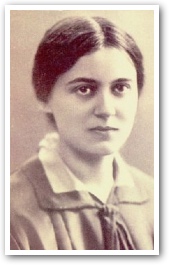
While she took the popular imagination by storm, quietly, in a convent half-way around the world, a German Jew named Edith Stein was developing an anthropology of womanhood which would lay the foundation for Pope John Paul II’s seminal Theology of the Body. His apostolic letter Mulieris Dignitatem (On the Dignity of Women) would enshrine many of Edith Stein’s ideas within the cultural landscape of modern Christianity and, by extension, the Western world.
John Paul II wrote Mulieris Dignitatem in the 1980’s, at a time when the world was still riding the wake of third-wave feminism. While such thinkers as Betty Friedan were investigating “The Feminine Mystique,” John Paul II was writing about “the feminine genius.” In the center of this cultural discussion, a new era of Wonder Woman was emerging onto the small screen–Lynda Carter’s The New Original Wonder Woman. As feminism was born and reborn and comic book Wonder Woman was adapted to each successive intellectual landscape, this iteration promised a return to the 1940’s ideals of her original incarnation, putting her very easily back into dialogue with the feminist thinkers of the 30’s and 40’s, including Edith Stein. On the surface, one would think that a secular feminist ideal like Wonder Woman, born from the rather dubious psychological research of a man like William Moulton Marston and obviously in dialogue with the cultural revolution of the 70’s and 80’s as well, would have little in common with the ideas of a traditional German Jewish-Catholic nun writing in the lead-up to the pogroms and destruction of World War II. It is therefore surprising that in many ways, the New Original Wonder Woman almost embodies them.
For all its evils, World War II did offer a sudden wealth of new possibilities to women. It cracked open the wall that had previously divided “men’s work” from “women’s work.” The expanding role of women in the world came with an expanding feminist philosophy. Edith Stein, one of those philosophers, noted “[I]n the last few years women’s sphere of action has been expanded from the home to the world” (154). Traditionally, “women’s sphere” had been considered the home, and men belonged in the world; but Stein saw the shift of women entering into “man’s world” as a good, and even necessary thing, something that fulfilled the highest calling of womanhood. To the Catholic Stein, the defining qualities of woman were best seen through her calling at her creation: as companion (someone who comes alongside another, a helper); mother (nurturing humanity to its full potential); and, thanks to the proto-evangelium, uniquely (but not exclusively) the enemy of evil. The first quality manifested itself in the “authentic feminine longing to remedy human need” (Stein, 259) and the calling “to sustain, to counsel, to help” (Stein, 264), while the second involved giftings “to bring true humanity in oneself and others to development” (Stein, 264-5). This is a role necessarily played not just at the level of the home, but at a societal, national, and global level as well. It required women fulfilling this calling within the “world of men,” in a manner distinct from men. Feminism of the 30’s and 40’s, in contrast to later waves, tended to focus on the ways women could contribute to the world as women: “the midcentury priority was ending the unequal valuing of gender differences, not ending the difference itself” (Held, 62). Following this line of thought, Edith Stein asserted that women couldn’t happily fulfill their calling by being forced to do it just like a man; rather they should fulfill a man’s place in a woman’s way. The feminist ideology that Marston, Wonder Woman’s creator, referenced similarly emphasized the unique power and giftings of women, and what they could bring to “man’s world” as women, although in a larger-than-life way: he envisioned that “freed and strengthened by supporting” one another, women would develop “enormous physical and mental power” and use it to “save the world from the hatred and wars of men” and help humanity to “find its maturity” (Held, 51-2).
What were these unique giftings and strengths? Primarily, they are reflective of Edith Stein’s idea of women’s special calling to motherhood–that is, in broader terms, the cultivating of humanity, especially in fields which can become easily forgetful of it. She wrote that women’s calling was “to bring true humanity in oneself and others to development” (264-5). Concretely, this meant that “[e]verywhere the problem is to save, to heal endangered or demoralized humanity, to steer it into healthy ways” (Stein, 263), and this was a problem that women, specially equipped by the biological reality of motherhood for “consideration of the whole being” (Stein, 264-5), were uniquely positioned to help solve. This is Wonder Woman’s goal: to “make bad men good, and weak women strong” (Held, 16). The New Original Wonder Woman opens with this sentiment epitomized in its theme song, which excitedly declares the heroine will “make a hawk a dove / stop a war with love / make a liar tell the truth.” Each of these scenarios are ones in which humanity is alleviated and elevated from its baser instincts to ideal, better behavior, its humanity being nurtured into what it more truly ought to be. Wonder Woman’s way of fighting evil is to increase the humanity of those committing it till they no longer want to, by countering their one-sided masculine excesses with her own balanced femininity.
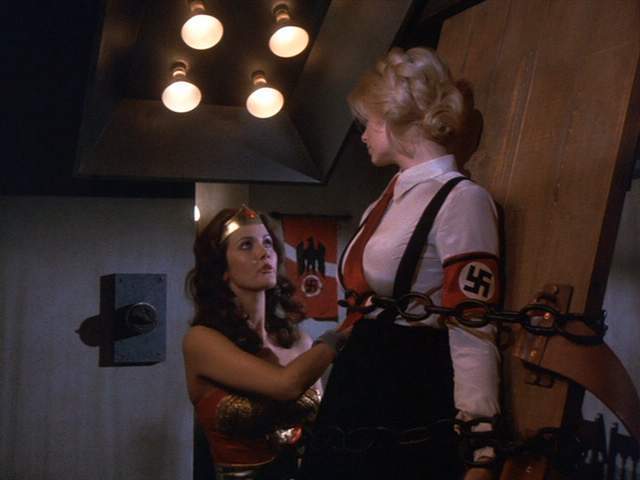
Edith Stein believed that this method of fighting evil was inherent in woman’s calling to motherhood as well; in fact, that women were called in a special way to be the particular enemy of evil. As a Catholic thinker, she drew this conclusion primarily from the proto-evangelium: after God has set punishments upon mankind and the serpent for their transgressions in the garden, He declares that woman’s offspring will be the serpent’s defeat. This declaration sets the woman as the particular enemy of the evil serpent till its doom is accomplished, a rivalry which carries through a long line of biblical images (Deborah, Jael, Esther, Judith, Mary) right down to the image of the woman and the serpent again in Revelations. Stein concludes from this that “[i]t has been woman’s mission to war against evil and educate her posterity to do the same” (198); indeed that “God has specifically enjoined her to combat evil” wherever she may find it (263). She writes that it is especially her mission to counter the degeneracy of man, which leads to the corruption of his mission to protect into a drive for domination, enslavement, and “brutal despotism” (whereas women if left unchecked could degenerate into servile dependence on man and descent into mere sensuality rather than substantiality) (190). It is interesting to consider this in light of Wonder Woman’s role in her world–to combat the despotism of Nazi Germany by “making bad men good and weak women strong” (Held, 16). In The New Original Wonder Woman, the heroine is faced both with despots whom she must counter with her lasso of truth, and women such as the “Nazi Wonder Woman” Fausta who, while appearing strong, is in reality being used by her superiors whom she is servile to. Wonder Woman is devoted to freeing these people from the tangle of lies in which they live and is constantly seeking the freedom of those being denied it. Edith Stein recognized this support of freedom as a corollary of women seeking to develop individuals’ humanity into maturity. She enjoins women to “seek God’s image in each human being and want, above all, to help each human being with his freedom” (259), an injunction Wonder Woman embodies “in her satin tights / fighting for our rights / and the old red, white and blue” (New Original Wonder Woman). Her pursuit of freedom and humanity is reminiscent of the Old Testament cry of Deborah, seeking to free the Israelites from slavery: “Village life ceased, it ceased in Israel / Until I, Deborah, arose, / Arose a mother in Israel.” (Judges 5:7 KJV).
“Our technology runs the risk of becoming inhuman. Reconcile men with life and above all, we beseech you, watch carefully over the future of our race. Hold back the hand of man who, in a moment of folly, might attempt to destroy human civilization.”
-John Paul II, Letter to Women
Moreover, neither Edith Stein’s womanly ideal nor Wonder Woman herself are set to accomplish this mission alone. Rather, they are to accomplish it by coming alongside others–by companionship. To Stein, this reflects the “authentic feminine longing to remedy human need” (264). They fulfill their role as the enemy of evil and nurturer of humanity by being the helpmate in man’s “battle for existence” (Stein 109). As we have seen, this is not a servile position, but as an equal and contributor, ready “to sustain, to counsel, to help” (Stein 264). We see this in Wonder Woman’s coming alongside those in “man’s world” within the war and in particular alongside Steve Trevor, her love interest. While she is happy to come alongside him and contribute to him and his work, it never demeans or devalues her to do so. She remains the center of the story, even while she is in the role of what would generally be called a side character–a simple office secretary. When others try to demean her in that role, the joke is always on them–they appear foolish for doing so, rather than making Diana seem so. Diana Prince, alias Wonder Woman, becomes a tribute to all women, working steadily, quietly, often overlooked or overshadowed by man’s ego, and yet undiminished in power. She is an ordinary woman doing a usual woman’s job, and it sends a clear message that she is also Wonder Woman. Wonder Woman might be any woman. We see her power even while she is content to be hidden. She is the feminine genius, a constant reminder of the personhood of all humanity. This is what the thinkers of the 30’s and 40’s hoped for; what John Paul II called for in his letter to women. Everywhere, the need for the female influence was felt. And perhaps, in this new social structure, it was making its way. The thrust of this form of feminism was in demanding that women be treated not like men but like human beings.
Edith Stein remarked once in an essay on women in national life, how easy it was to “find true heroines in all walks of life. They perform wonders on the job, in their families, professions, and in the cloister” –wherever they may be found. She might have been talking about Wonder Woman.
Sources
Held, Jacob (ed.) Wonder Woman and Philosophy. Blackwell, 2017, Oxford.
John Paul II. Mulieris Dignitatem. 1988. Vactican.va. Accessed August 19, 2024.
John Paul II. Letter to Women. 1995. Vactican.va. Accessed August 19, 2024.
The New Original Wonder Woman: Season One, written by Stanley Ralph Ross, produced by Douglas S. Kramer, Warner Brothers, 2004.
Stein, Edith. Essays on Woman. (2nd ed.) Trans. Freda Mary Oben. ICS Publications, 1987.
 The Feminine Genius
Leave a comment